HSE Tikhonov Moscow Institute of Electronics and Mathematics

Tag "international cooperation"

HSE University Signs Cooperation Agreements with Leading Chinese Universities

Qiu Yong, Nikita Anisimov, Gong Qihuang
On May 8, 2025, in Moscow, in the presence of Russian President Vladimir Putin and Chinese President Xi Jinping, strategic agreements were signed between the HSE University and two of China's top institutions, Peking University and Tsinghua University. The event was attended by Nikita Anisimov, Rector of HSE University, Qiu Yong, Secretary of the CPC Tsinghua University Committee, and Gong Qihuang, President of Peking University. The signing unfolded during the official visit of the Chinese delegation to Russia, coinciding with the commemoration of the 80th Anniversary of Victory Day.

HSE Expands Cooperation with Chinese Universities

HSE Expands Cooperation with Chinese Universities
An HSE delegation, led by Rector Nikita Anisimov, visited China for negotiations with the administration of the country’s top universities. The parties agreed to expand bilateral scientific and educational collaboration and signed several documents. In particular, a strategic partnership agreement was established with Peking University, one of the oldest and most prestigious educational institutions in China.

‘Studying at the University of Bologna Is Very Different from How We Study at HSE’

Alina Pakhomova
Alina Pakhomova, a fourth-year student of the Bachelor’s Programme ‘Information Science and Computation Technology’ at the HSE Tikhonov Moscow Institute of Electronics and Mathematics (HSE MIEM), spent six months studying at the oldest university in Europe — the University of Bologna. She went to Italy as part of an academic mobility programme, and upon returning to Moscow, she shared her impressions of life and studying abroad, her leisure activities, new friends, and, of course, the famous Italian cuisine.

A Dorm in a Palace, Tests without Grades, and Immersion in ML: Studies in Armenia under an HSE Mobility Programme

A Dorm in a Palace, Tests without Grades, and Immersion in ML: Studies in Armenia under an HSE Mobility Programme
Alisher Yuldashov, second-year student of the HSE University Master's Programme 'Internet of Things and Cyber-physical Systems', went to the Russian-Armenian University of Yerevan under an academic mobility programme. Alisher shared his thoughts about the educational process, the programme curriculum, and his impressions of life in the capital of Armenia.

MIEM and HSE Design School Meet with Indonesian Game Dev Representatives

MIEM and HSE Design School Meet with Indonesian Game Dev Representatives
In December, the Indie Go space hosted a meeting with representatives of Indonesia’s game development industry. Colleagues from the ‘Game Engineering and Interactive Systems’ workshop of the HSE Tikhonov Moscow Institute of Electronics and Mathematics (MIEM) and the HSE Art and Design School learned about the intricacies of the Indonesian game industry and told the visitors about their own projects.

HSE Researchers Develop New Method for Analysing Genetic Admixture of Populations

HSE Researchers Develop New Method for Analysing Genetic Admixture of Populations
Researchers of the HSE International Laboratory of Statistical and Computational Genomics together with their international colleagues have proposed a new statistical method for analysing population admixture that makes it possible to determine the time and number of migration waves more accurately. The history of Colombians and Mexicans (descendants of Native Americans, Spaniards and Africans) features two episodes of admixture that occurred about 350 and 200 years ago for Mexicans and 400 and 100 years ago for Colombians. The results were published in the Plos Genetics journal.

‘International Students Who Aren’t in Russia for the Start of the Academic Year Can Study Remotely’

‘International Students Who Aren’t in Russia for the Start of the Academic Year Can Study Remotely’
The new reality presents a number of issues for international students—particularly those joining HSE University in 2022. What changes will there be in the university’s education system? What will happen if a student is unable to come to Moscow by September 1? What is the university doing to help international students adapt? Vice Rector Ivan Prostakov spoke to the HSE News Service to answer these questions and more.

Faculty of Computer Science and MIEM Entrepreneurs Present Student Projects in Kazakhstan

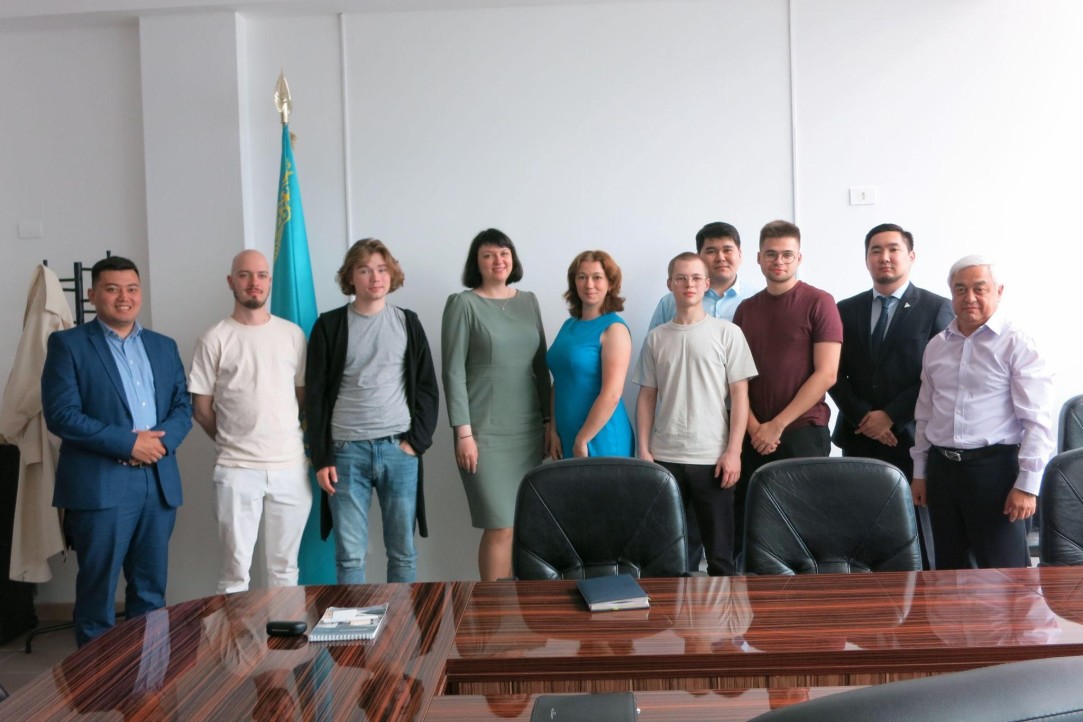
Meeting with representatives of Astana Innovations
In June, a delegation from the FCS and HSE MIEM visited Nur-Sultan, the capital of Kazakhstan, to present student start-ups to the IT community. The trip was organised as part of a programme to develop entrepreneurship among undergraduate and doctoral students of the HSE University Faculty of Computer Science.

Chemists Suggest Using Polymeric Ionic Liquids in Supercapacitors

Chemists Suggest Using Polymeric Ionic Liquids in Supercapacitors
A team of researchers from HSE MIEM joined colleagues from the Institute of Non-Classical Chemistry in Leipzig to develop a theoretical model of a polymeric ionic liquid on a charged conductive electrode. They used approaches from polymer physics and theoretical electrochemistry to demonstrate the difference in the behaviour of electrical differential capacitance of polymeric and ordinary ionic liquids for the first time. The results of the study were published in Physical Chemistry Chemical Physics.

Researchers Propose Method to Increase Charge of Supercapacitors

Researchers Propose Method to Increase Charge of Supercapacitors
Researchers from HSE MIEM and the Institute of Non-Classical Chemistry in Leipzig have proposed a new theoretical model of supercapacitors that takes into account the properties of a cation, which considerably impacts the electric differential capacitance of supercapacitors. This is the first publication of its kind in electrochemistry. The authors believe that the model will allow engineers to create more powerful energy sources in the future. The results of the study were published in The Journal of Physical Chemistry C. The study was completed with support from a grant by RSF.